
If you’ve ever tried to “trust your intuition” and felt like nothing happened, you’re not broken — you’ve probably just been listening for the wrong signal.
Intuition isn’t one universal experience. It doesn’t feel the same for everyone, and it doesn’t show up the same way twice. Most people have one or two dominant intuitive languages, and once you know which ones are yours, the whole idea of “trusting your gut” finally starts to make sense.
Here’s a simple breakdown of the four.
1. Seeing — Clairvoyance
This is the most commonly pictured form of intuition, but it’s also often misunderstood. Clairvoyance isn’t about seeing ghosts — it’s about receiving information visually. That might look like flashes of images, symbols, or mental pictures that arrive out of nowhere. If you’re someone who “sees” how a situation is going to play out before it happens, or gets a strong visual impression when you think about a person or decision, this is likely one of your channels.
In everyday life, this can look a lot less mystical than it sounds. Maybe you pictured a specific parking spot right before you found it. Maybe you had a flash of a friend’s face right before they called. Maybe you can’t picture a room without instantly rearranging the furniture in your head, or you “see” how an outfit will look before you put it on. If your daydreams feel more like movies than thoughts, that’s clairvoyance quietly doing its job.
2. Feeling — Clairsentience
Clairsentience is energetic and emotional. You pick up on the mood of a room before anyone says a word. You know something is wrong with a person you love before they tell you. This is also the intuitive type most likely to blur into empathy — clairsentients often absorb other people’s emotions as if they were their own, which is why learning to tell the difference between “your” feelings and what you’re picking up from someone else is such an important skill for this type.
This one tends to show up in the body first. You walk into a room and suddenly feel exhausted or tense, and it lifts the second you leave — that wasn’t your energy, that was the room’s. You’ve probably had a “bad feeling” about a person you just met, with zero evidence to back it up, and been right anyway. Crowded places might drain you fast, or you might cry at things that aren’t really about you at all. If you’ve ever been told you’re “too sensitive,” there’s a good chance what people were really noticing was this gift.
3. Hearing — Clairaudience
Clairaudience shows up as an inner voice, a phrase, or a thought that doesn’t quite feel like it came from you. It’s not usually literal voices — it’s more like a sentence dropping into your head that answers a question you hadn’t even finished asking yet. If you’ve ever had a thought arrive so clearly it startled you, that’s likely this channel at work.
This can be as simple as hearing “call your mom” out of nowhere, right before you find out she needed you. Or a song lyric popping into your head that ends up being exactly what you needed to hear that day. Some people describe it as their own voice, but with a different tone — calmer, more certain, like it’s not coming from the anxious, chattering part of their mind. If you talk to yourself a lot, or think best out loud, this channel is probably wide open for you already.
4. Knowing — Claircognizance
This is the quietest of the four, and often the hardest to trust because there’s no image, feeling, or voice attached to it — just certainty. You simply know something. Claircognizants often struggle with self-doubt because their guidance doesn’t come with any obvious “proof” attached to it. It just arrives, fully formed, and it’s usually right.
This is the friend who “just knew” the relationship wasn’t going to work out, months before the breakup, with no real reason to point to. It’s deciding not to take a job and finding out later the company folded. It’s the sudden certainty that you need to leave five minutes earlier than usual — no reason, you just do. Claircognizance rarely comes with goosebumps or a dramatic moment attached. It just quietly turns out to be right, over and over, which is usually how people with this gift finally start taking it seriously.
So which one is yours?
Most people lead with one or two of these, and the rest sit quieter in the background. The mistake most beginners make is trying to force themselves into a channel that was never theirs to begin with — spending months trying to “see” visions when their real gift was always the quiet certainty of knowing.
That’s exactly why generic advice like “meditate more” or “just trust yourself” so often falls flat. It’s not wrong — it’s just incomplete. It doesn’t tell you how to trust yourself, because it doesn’t know which language you’re supposed to be listening for.
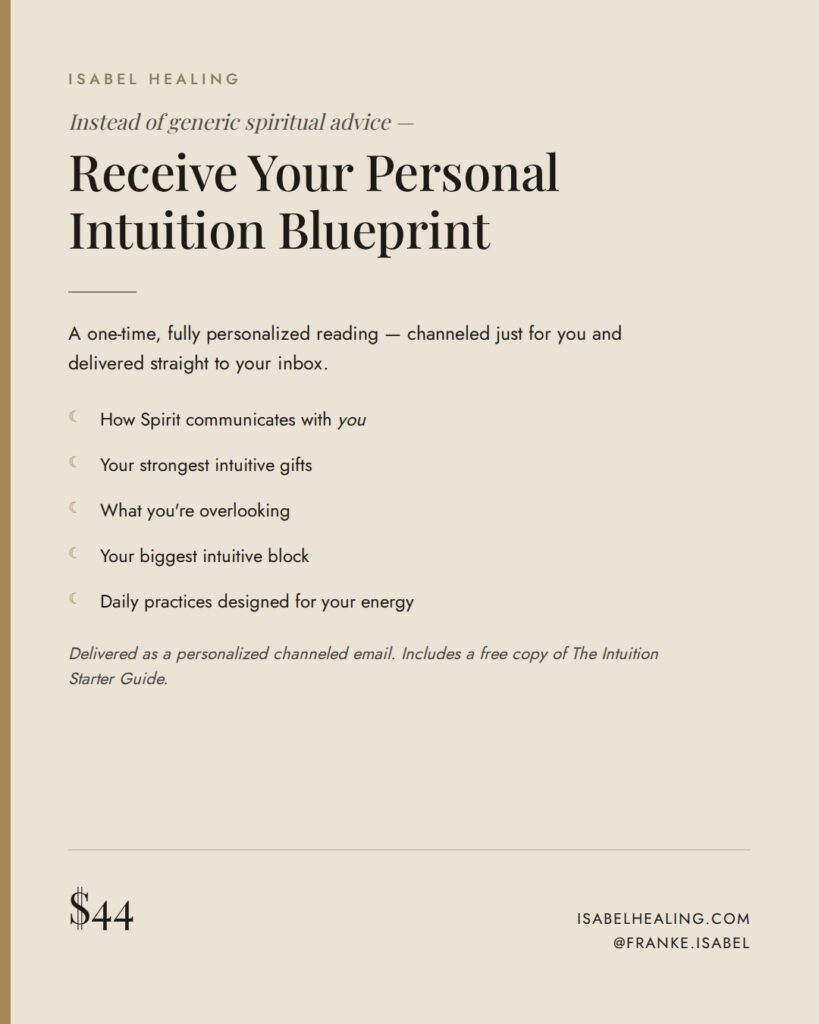
If you’re ready to find out — not guess, actually find out — how Spirit communicates with you specifically, that’s exactly what the Intuition Blueprint was built for. It’s a personalized, channeled reading that identifies your strongest gifts, what you’ve been overlooking, your biggest block, and daily practices built around your actual energy, not a generic template.
Ready to stop guessing? Get your Intuition Blueprint →